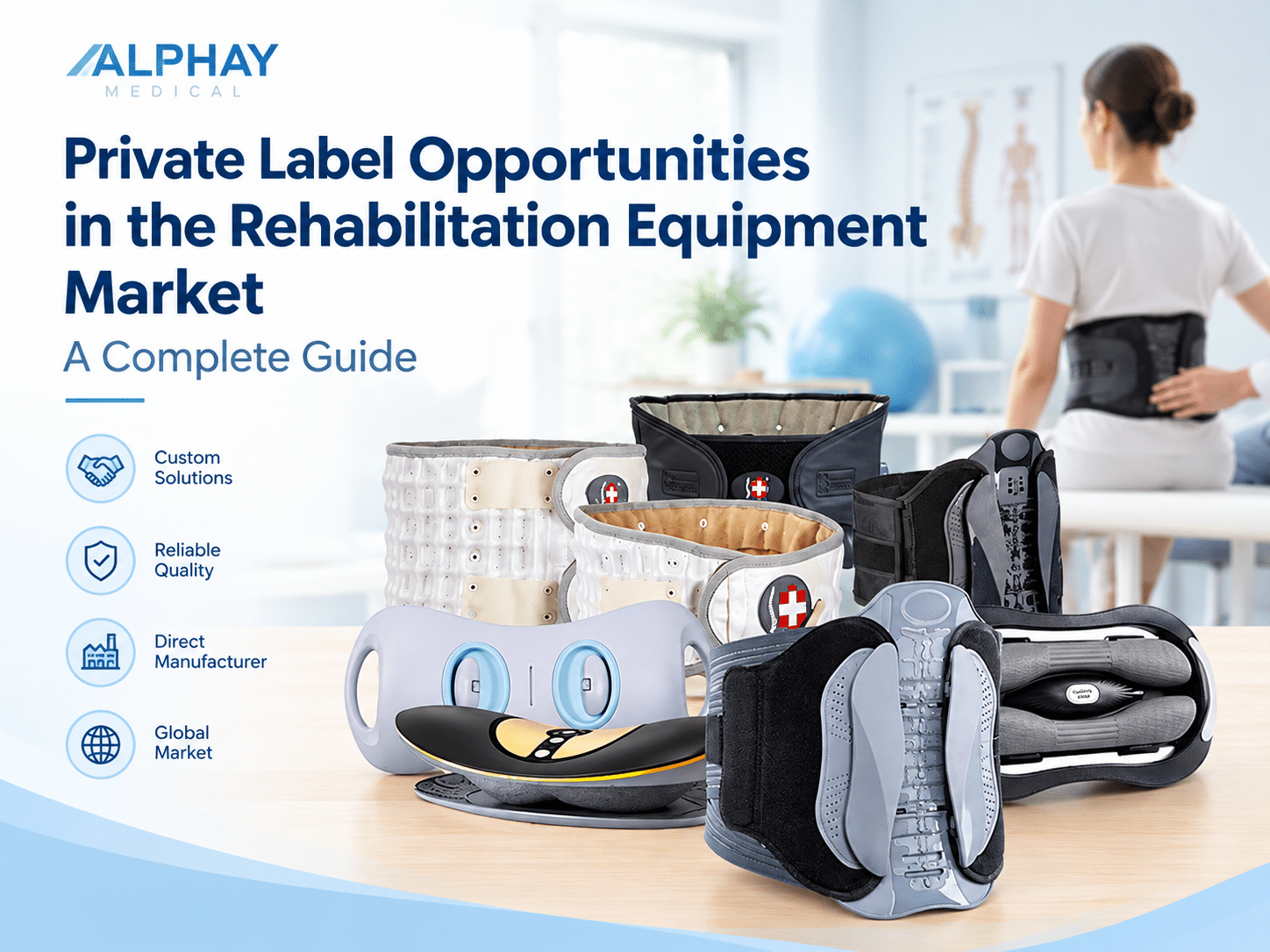
Private Label Opportunities in the Rehabilitation Equipment Market: A Complete Guide
The rehabilitation equipment market is changing.
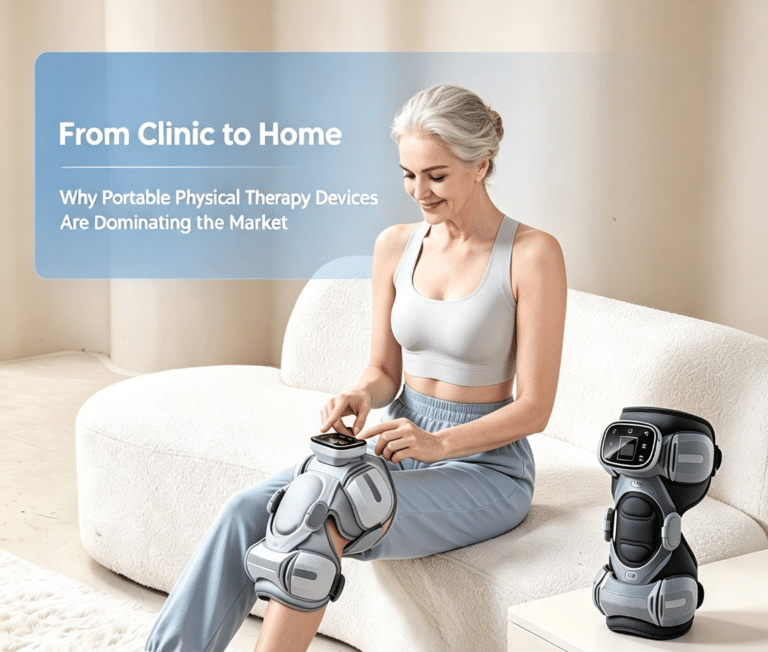
Consumers are no longer relying exclusively on hospitals and physical therapy clinics for everyday care. More people are looking for convenient products they can use at home, while retailers and healthcare brands are expanding their product lines to meet that demand.
For distributors, importers, e-commerce brands, and healthcare retailers, this shift creates an attractive opportunity: private label rehabilitation equipment.
Instead of building a product from scratch, a brand can work with an experienced manufacturer, customize an existing product, put its own branding and packaging on it, and bring it to market much faster.
For businesses that want to enter the home physiotherapy market without taking on the cost and risk of developing an entire product line themselves, private label can be a smart place to start.
What Is Private Label Rehabilitation Equipment?
Private label means a manufacturer produces a product that is sold under the buyer’s own brand.
The manufacturer may already have a proven product design and production process, while the buyer controls how the product is presented to the market.
Depending on the project, customization may include:
- Brand logo
- Product colors
- Packaging
- User manuals
- Accessories
- Product configuration
- Selected functions
- Retail positioning
For example, instead of selling a generic neck traction device, a distributor can work with a neck traction device manufacturer to develop a branded version specifically for its target market.
The same approach can be applied to lumbar traction devices, knee massagers, neck massagers, and other home physiotherapy products.
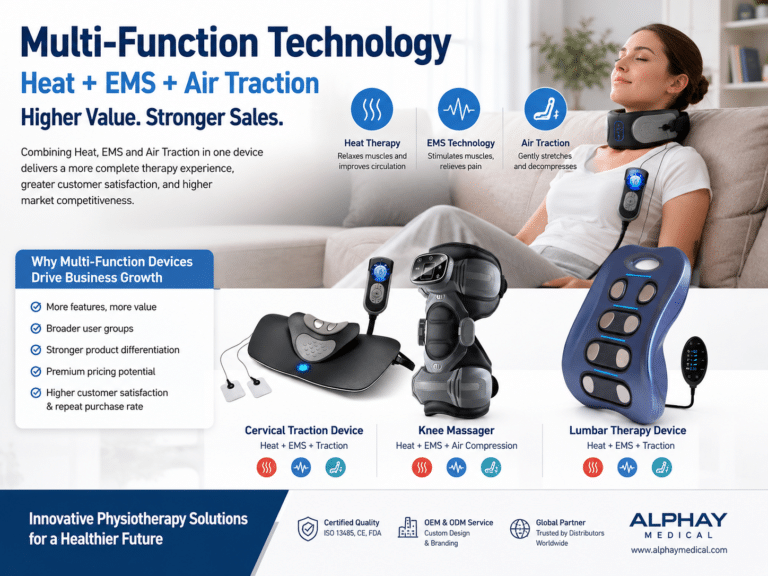
Alphay Medical’s current product portfolio includes cervical care devices, neck and shoulder massage pillows, smart neck massagers, lumbar traction devices, knee care massagers, and airwave joint massagers, giving private-label buyers multiple categories to build a product line around.
Why Private Label Is Attractive to B2B Buyers
1. Faster Time to Market
Developing a completely new medical or rehabilitation device can take considerable time.
You need product design, engineering, prototyping, testing, tooling, packaging, and production.
Private label can shorten that process by starting with an existing manufacturing platform.
For example, Alphay’s cervical care device JKAH-3 already combines functions such as dynamic air traction, heating, and low-frequency pulse massage. Its product page also lists customizable color, a 5-piece MOQ, and a 500-piece customization quantity.
For a distributor testing a new market, this can be much more practical than investing in a completely new product from day one.
2. Lower Product Development Risk
Launching a new healthcare product always involves uncertainty.
Will customers like the design?
Will the price work?
Will retailers accept it?
Will the product generate repeat sales?
Private label allows brands to reduce some of that upfront risk by starting with an established product platform.
A buyer can test demand, collect customer feedback, and then decide whether to invest in deeper customization.
That’s particularly useful for companies entering the rehabilitation equipment market for the first time.
3. Build Your Own Brand Instead of Selling a Generic Product
This is one of the biggest advantages of private label.
If you simply resell a generic product, your customers may compare your price with dozens of other sellers.
Your brand becomes difficult to differentiate.
With private label, the same basic product can become part of a broader brand strategy.
You can build a consistent identity across:
- Product design
- Packaging
- Website
- Amazon or e-commerce listings
- Retail displays
- Social media
- Customer service
For example, a healthcare brand could create a complete home-care collection featuring a branded neck traction device, lumbar therapy product, knee massager, and neck and shoulder massager.
That gives the business a much stronger product story than selling unrelated generic products.
4. There Are Multiple Private Label Categories to Choose From
The rehabilitation and home physiotherapy market is not limited to one product category.
This gives distributors room to build a product portfolio based on their target customers.
Neck Traction Devices
Cervical traction products are a natural fit for brands focused on neck care and home rehabilitation.
Alphay’s product range includes multiple cervical traction models, including adjustable and air traction designs. Some models are positioned for home and everyday use, while others are designed as medical devices for specific applications.
For buyers, relevant supplier searches include:
Neck Traction Device Supplier
Neck Traction Device Manufacturer
Cervical Traction Device Factory
Lumbar Traction Devices
Back-care products are another strong category for private-label brands.
Alphay’s lumbar product range includes devices combining functions such as air traction, massage, thermal therapy, and electrical pulse functions.
This creates opportunities for brands that want to position their products around home back care, relaxation, recovery, or physiotherapy.
Potential B2B search terms include:
Lumbar Traction Device Manufacturer
Lumbar Traction Device Supplier
Lower Back Massager Factory
Knee Massagers and Joint Care Products
Knee and joint-care products can help brands reach another customer group, including older consumers, active adults, and people interested in everyday recovery.
Alphay’s airwave joint massager, for example, combines airbag kneading with thermal and vibration massage functions.
For buyers, relevant supplier searches include:
Knee Massager Manufacturer
Knee Massager Supplier
Joint Rehabilitation Equipment Factory
Neck and Shoulder Massagers
Neck and shoulder products can also be attractive private-label products because they sit between healthcare, wellness, and everyday personal care.
Alphay currently offers multiple neck and shoulder products, including cervical care massagers and massage pillows.
Relevant B2B keywords include:
Neck Massager Manufacturer
Neck Massager Supplier
Neck and Shoulder Massager Factory
What Can You Customize With Private Label?
Private label doesn’t necessarily mean putting a logo on an existing product and calling it a day.
The best supplier relationships allow buyers to customize the product around their market.
Logo & Branding
Your logo is usually the starting point.
Depending on the product, branding can be applied to the device, controller, packaging, or accessories.
Product Color
A custom color can make a private-label product look significantly different from a standard factory version.
This is particularly useful for brands with an established visual identity.
Packaging
Packaging is often overlooked by first-time buyers.
For retail and e-commerce businesses, however, packaging plays an important role in:
- Shelf presentation
- Unboxing experience
- Brand recognition
- Product positioning
Product Configuration
More experienced private-label buyers may also customize selected functions or configurations.
The key is to work with a rehabilitation equipment manufacturer that has its own R&D capabilities rather than simply acting as a trading company.
Private Label vs. OEM vs. ODM: What’s the Difference?
These terms are often used interchangeably, but there are practical differences.
| Model | Best For | Investment | Customization | Time to Market |
|---|---|---|---|---|
| Private Label | New brands & distributors | Low–Medium | Medium | Fast |
| ODM | Brands seeking factory-developed products | Medium | Medium–High | Fast–Medium |
| OEM | Established brands with their own specifications | High | High | Medium–Long |
For many businesses, private label is the first step.
Once sales are established, the company can move toward deeper ODM or OEM development.
How to Choose a Private Label Rehabilitation Equipment Supplier
Choosing the right factory can make or break a private-label project.
Don’t make the decision based solely on the lowest unit price.
Here are seven things B2B buyers should evaluate.
1. R&D Capability
Does the manufacturer have its own engineering and product development team?
A strong R&D team makes it easier to customize products and develop future models.
Alphay Medical describes itself as an original manufacturer with a product center supported by NPD engineers, industrial designers, and graphic designers.
2. Product Range
A supplier with multiple product categories can make portfolio expansion easier.
Instead of finding one supplier for neck products, another for lumbar products, and another for knee products, buyers may be able to consolidate more of their sourcing with one manufacturer.
3. Quality Management and Certifications
Healthcare-related products require more attention to quality and compliance than ordinary consumer goods.
Buyers should ask suppliers for the certifications and regulatory documentation relevant to the specific product and destination market.
Alphay’s website identifies quality systems and product certifications including ISO 9001, ISO 13485, CE/MDR, FDA, RoHS and other certifications for its product categories. Buyers should verify the exact certification scope and applicability for each model before importing.
4. MOQ Flexibility
Large MOQs can be a major barrier for smaller brands.
A supplier offering flexible quantities can make it easier to test a new product before committing to a large production run.
Some Alphay product pages currently list low starting MOQs alongside larger quantities for customization.
5. Production Capacity
A supplier may be able to handle a small trial order but struggle when demand increases.
Ask about production capacity, lead times, quality control, and how the factory handles repeat orders.
6. OEM & ODM Experience
Look for a supplier that has experience working with overseas brands, distributors, and private-label customers.
Alphay states that it has worked with brands and customers across markets including the U.S., Europe, Korea, Japan, Southeast Asia, and the Middle East.
7. Communication and After-Sales Support
A good factory relationship doesn’t end when the goods leave the warehouse.
Clear communication about product specifications, packaging, documentation, replacement policies, and future orders can save buyers a lot of headaches.
How to Build a Private Label Product Line
You don’t need 20 SKUs to launch a healthcare brand.
A better approach is to start with a focused product portfolio.
For example:
Core Product
Neck Traction Device
Target customers: neck-care and rehabilitation users.
Second Product
Lumbar Traction Device
Target customers: back-care and home physiotherapy users.
Third Product
Knee Massager
Target customers: joint-care and recovery users.
Fourth Product
Neck & Shoulder Massager
Target customers: wellness, office-worker, and everyday relaxation markets.
This creates a logical product family while allowing the brand to test different customer segments.
Once the best-selling products are identified, the brand can expand the range.
What Makes a Private Label Product Successful?
A private-label product isn’t successful simply because it has a custom logo.
The winning combination is usually:
Good Product + Clear Positioning + Reliable Factory + Competitive Cost + Strong Branding
Your manufacturer should handle the production side.
Your brand should focus on:
- Who the product is for
- Why customers need it
- How it is different
- Where it will be sold
- How much customers are willing to pay
That’s where a strong factory partnership becomes valuable.
Why Work With Alphay Medical?
Alphay Medical is a China-based OEM and ODM manufacturer specializing in massage products and home physiotherapy equipment.
Founded in 2006, the company offers products including neck massagers, lumbar massagers, knee massagers, cervical traction devices, lumbar traction devices, back support products, and other home healthcare equipment.
For private-label buyers, Alphay provides support across product development, customization, manufacturing, and packaging.
The company also states that it can customize product appearance, functional configuration, and packaging according to customer requirements.
Whether you’re looking for a neck traction device supplier, lumbar traction device manufacturer, knee massager factory, or home physiotherapy equipment manufacturer, having one experienced manufacturing partner can simplify sourcing and make it easier to expand your product line.
Ready to Build Your Rehabilitation Product Brand?
The rehabilitation equipment market offers plenty of room for new brands—but success depends on choosing the right products and the right manufacturing partner.
Private label gives distributors and healthcare brands a practical way to enter the market, test demand, and build a recognizable product portfolio without starting every product from scratch.
The key is to find a manufacturer that can offer more than competitive pricing.
You need product development, customization, quality control, production capacity, certifications, and reliable communication under one roof.
That’s where Alphay Medical can help.
Request Factory Quote Now
Looking for a reliable OEM medical device manufacturer for your private-label rehabilitation products?
Contact Alphay Medical for factory-direct pricing and OEM/ODM solutions.